

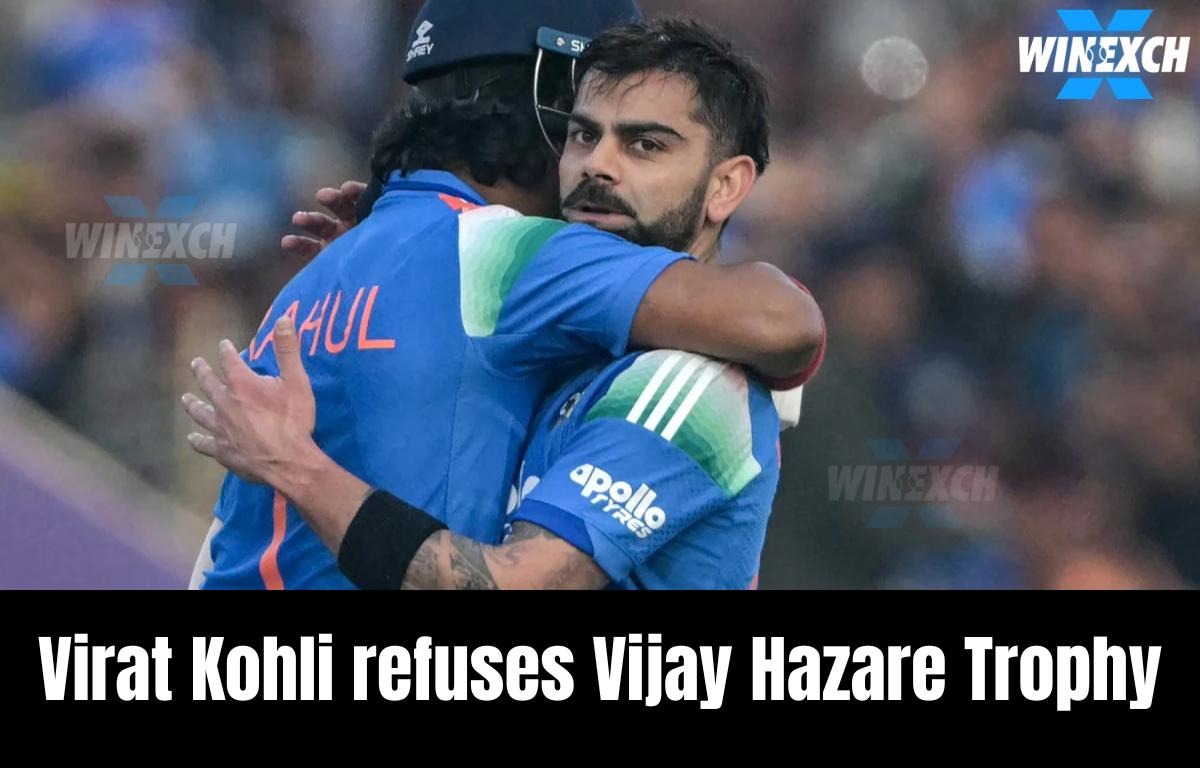
Virat Kohli Vijay Hazare Trophy exit sparks BCCI Crisis
Virat Kohli Vijay Hazare Trophy Exit Leaves BCCI in Crisis
This news of Virat Kohli Vijay Hazare Trophy exit leaves everyone in shock, as he refuses to play in the league. According to plenty of media outlets like Winexchange, Kohli has declined to participate in the domestic one–day tournament, even as Rohit Sharma confirmed his availability for the same.
The development has taken the Board of Control for Cricket in India (BCCI) and the current coaching set-up, led by Gautam Gambhir, by surprise, if reports are to be believed. Even a player as big as Kohli, the BCCI seems to imply, can’t be treated any differently than the rest of the team.
There is, however, more to this than a simple refusal to play – there’s a broader tension around what senior players were expected to do in domestic cricket and issues concerning equity and consistency through the team.
What Happened, Exactly: A Timeline
Kohli, it is understood, turned down the offer, and sources say Rohit himself expressed his willingness to play for his state side in Vijay Hazare (also make himself available for domestic T20 competition). According to insiders, Kohli had felt the “preparedness was excessive.” He reportedly believes in relying on his long–built foundation, physical fitness, and mental readiness rather than grinding through domestic cricket for match practice.
Earlier in the year, Rohit and Kohli had been convinced by the BCCI to play domestic cricket, particularly the Ranji Trophy, to stay in touch after a forgettable Test series in Australia.
But ahead of Vijay Hazare, the quotas appear to be stricter. The BCCI and the coaching staff are eager to ensure all centrally contracted players, except in cases where they are injured or unavailable during international duty, play domestic cricket. The Catch: Can an exception be made for one senior star? The answer, officially at least, seems to be no.
To make amends, BCCI has allegedly dispatched Pragyan Ojha, the national selector, to meet Kohli after its stars lost to South Africa in their first ODI match at Raipur. The idea was to negotiate peace between the batter and himself, the coach Gambhir.
The Bigger Picture
The controversy is not just about one tournament. It exposes some of the subterranean currents in the cricket: how seniority, expectations and equal treatment are being navigated within a squad that is changing rapidly. For decades, the likes of Kohli have been accommodated, according to legacy as much as workload and international matches. But with a new regime under Gambhir in place and the BCCI promoting fairness, that old deference may be put to question.
If exemptions become the norm for veterans, younger squad players could raise valid concerns: Why should some enjoy special treatment when domestic tournaments are supposed to be mandatory? That could erode team unity and discipline. And it may set a precedent that complicates future selection discussions.
For fans and interested parties, the development also represents a change in focus. The BCCI, it seems, is set on imposing local presence as a minimum pre-requisite, thereby proving the point that A-listers too must go through the same grind. Which could impact not just availability for shorter tournaments, but also player workload, performance expectations and longevity.
A Twist in the Tale: Kohli’s U-turn?
Interestingly, reports later today changed the narrative entirely. According to some reports in the media, the Delhi and District Cricket Association (DDCA) have stated that Virat Kohli Vijay Hazare Trophy will happen.
This abrupt about-face has not gone unnoticed. Is it a case of a serious change of heart following talks with selectors (example, Pragyan Ojha) or Gambhir? Or is it a calculated move to avoid friction within the BCCI and the dressing room? For BCCI, this helps salvage some normalcy. For Kohli, it saves optics. But the episode has already sparked enough speculation about internal tensions, team dynamics, and what senior players expect versus what is expected of them.
What This Could Mean for Cricket and Beyond
This saga reflects more than just a single tournament. It marks a possible turning point in how the cricket handles senior players and their roles in domestic squads. As the landscape evolves, new expectations are forming: whether it’s match fitness or fairness in selection.
Senior players like Kohli and Rohit may still enjoy respect and privileges, but perhaps not at the cost of uniformity and equality. The younger and future stars will observe closely how these rules are implemented. The health of national cricket in the long-term, though, could be served by instituting such norms to develop a culture where plays like these are unwelcome rather than excusable, regardless of how big your name.
For fans, it could symbolise a revived ethos: that even legends have to prove themselves again and again, not only on the international stage but in their domestic arenas.
Conclusion
And what started as a simple refusal has evolved into a multilayered flap that throws other tensions within national cricket into sharp relief. Whether it’s the seniority thing, or what became a pattern in domestic cricket prior to this series (players told not to place too much stock on the haphazard scheduling of some circuitous matches), changing dynamics under new leadership, those close observers will tell you that what went down around Virat Kohli Vijay Hazare Trophy was larger than meets the eye.
For the moment, however, with Kohli understood to have re-entered contention for the tournament, that short-term crisis might yet be averted. But the questions it prompted, about equality, accountability and fairness, will endure. And they could influence how national cricket deals with senior players in the years ahead.
For fans, selectors and platforms like Winexch the message is clear: the game is changing. The rules, on the field and off it, are also very much up in the air.
FAQs
1. Why did Virat Kohli not want to play in Vijay Hazare Trophy initially?
Sources indicate Kohli wasn’t comfortable with what he termed “too much preparation”. I think he was just more comfortable going back to what had got him there: his fitness, the base that’s in place and his belief rather than domestic one-day games.
2. Is even Rohit Sharma not available for the Vijay Hazare Trophy?
No. Rohit, according to reports, said “yes” for the domestic one-day event in a bid to keep his match-fitness intact.
3. Can the BCCI compel Kohli to play if he is not willing?
Technically, BCCI can order participation as a must for all those who are centrally contracted (save injury or being on national duty), but to impose it on a player of Kohli’s calibre without bringing upon itself backlash and morale issues would be another challenge.
4. Did Kohli finally play after the rumpus?
Yes. 41-year-old Kohli has made himself available for the Vijay Hazare Trophy, which is scheduled to start from the 18th of September, according to a recent DDCA release.