Winexchange Winexchange
 Breakdown of Formula With Match Examples and Impact on Points Table
The winexchange guide discusses the Net Run Rate formula methodically. Learn how the metric affects team rankings.
Net Run Rate helps rank teams in tournaments. It is used when teams have the same points.

Definition of Net Run Rate (NRR)
Difference Between Run Rate and Net Run Rate
Why NRR Is Important in Cricket Tournaments
Runs per over in one innings
Example: 170/20 = 8.50
Average across all matches
Example: 8.70 Bat RR - 6.30 Bowl RR = +2.500
How to Calculate Net Run Rate in Cricket
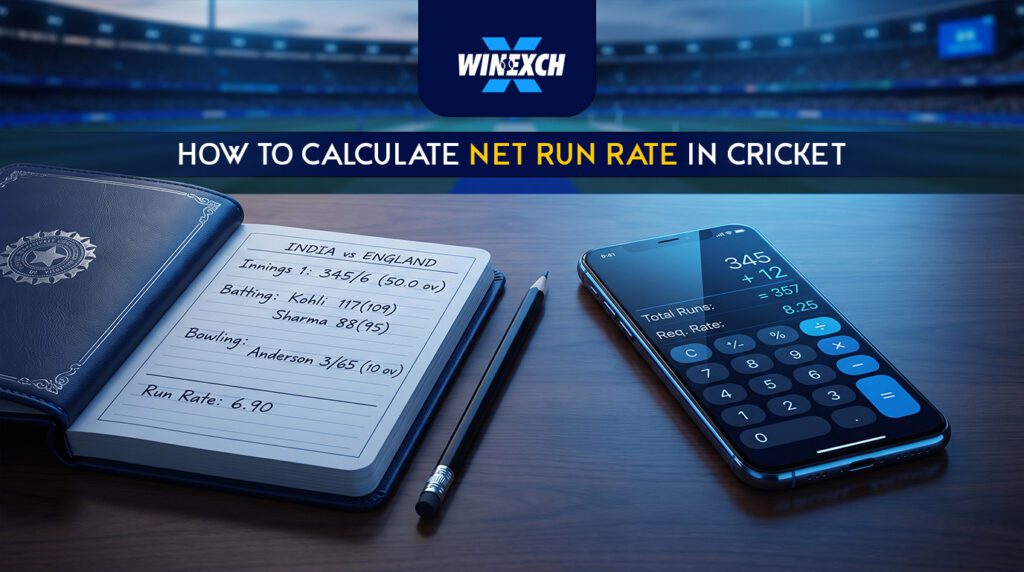
Official Net Run Rate Formula
Calculate Net Run Rate Step-by-Step
Understanding Runs Scored and Runs Conceded
Partial Overs to Decimal Conversion
1 Ball
0.167
1 Ball
0.333
1 Ball
0.500
1 Ball
0.667
1 Ball
0.833
1 Ball
1.000
Innings often end on incomplete overs. These need conversion for NRR.
Example: Let's take the example of 17.5 overs. Here, the full 17 overs will be counted. Additionally, for 5 balls, 5/6 = 0.833 overs.
Thus, the overall over in decimal will be 17.833.
Let us look at some practical examples by Winexch to understand the Net Run Rate Formula and its calculation.

Basic NRR Calculation
Team A vs Team B Example
Calculate Net Run Rate After Multiple Matches
Qualification and Elimination Scenarios
Tie-Breaker Situations
League Stage Rankings
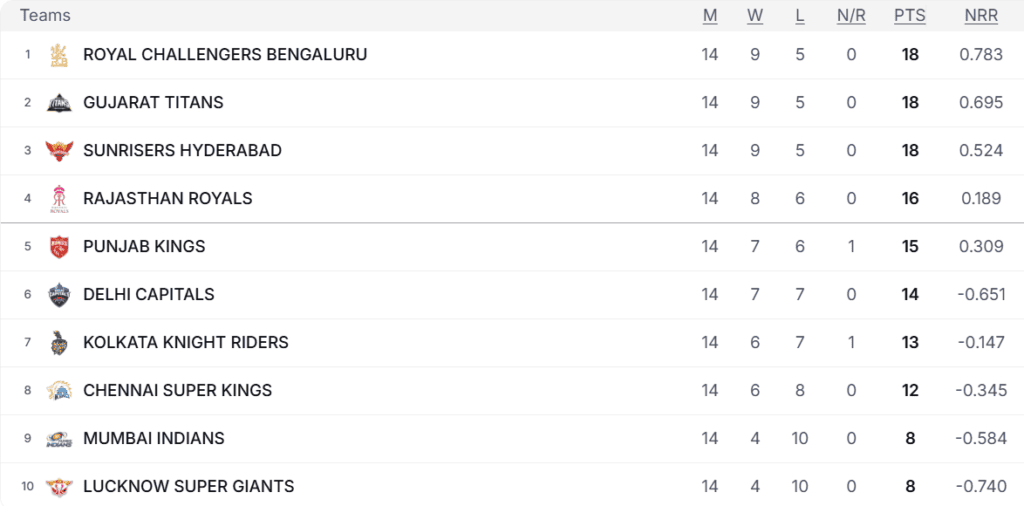
The rate value has high importance. It is used to determine the ranking during group stages. Learn cricket points table calculations.
IPL Qualification Scenario and Rules
NRR Impact on Playoff Spots
Real IPL Example
Common Mistakes While Calculating Net Run Rate
Errors in NRR calculation happen often.

Incorrect Overs Calculations
All-Out Innings Misunderstandings
Rain-Affected Match Calculations
Why Net Run Rate Matters in ICC Tournaments
ICC tournaments use NRR in different ways.

Asia Cup
ICC Cricket World Cup
T20 World Cup Qualification Scenarios
FAQs About Cricket Captions
A good NRR is generally anything above 1. The higher it gets, the better for the team's standing. It is a strong indicator of their overall performance. Additionally, teams with higher NRR often have an advantage in close tournaments.
NRR can easily be negative during any tournament. This happens when the sides lose the matches by a high difference.
When a team is bowled out, the calculation changes a bit. Calculate Net Run Rate with the full quota of overs. The actual overs they faced do not matter in this case. This is a standard rule that applies to all such innings.
All complete matches are considered for NRR. The DSL rule changes the scores. The revised targets are then used for all NRR calculations. Therefore, rain-affected matches follow different rules for this metric.
The required NRR depends heavily on the specific tournament and its format. Firstly, it needs to be positive. Then it should be at least 1. Generally, teams face trouble when it goes below 1.
No, a Super Over does not affect the NRR at all. It is treated separately from the main match for this purpose. The outcome of the Super Over decides the match result. However, it does not change the NRR figures of either team. Thus, calculate Net Run Rate without it.
Winexch offers an IPL Net Run Rate Calculator. This works on the above-given formula. Users just need to feed the values. It also works for events other than IPL.
No, matches with no result are not included in NRR calculations. Only matches that have a clear winner or loser count. This rule ensures that the NRR is based only on completed games. It keeps the metric fair for all participating teams.
Partial overs are converted using a simple method. Each ball is counted as one-sixth of an over. Afterwards, it gets added to the completed overs.