
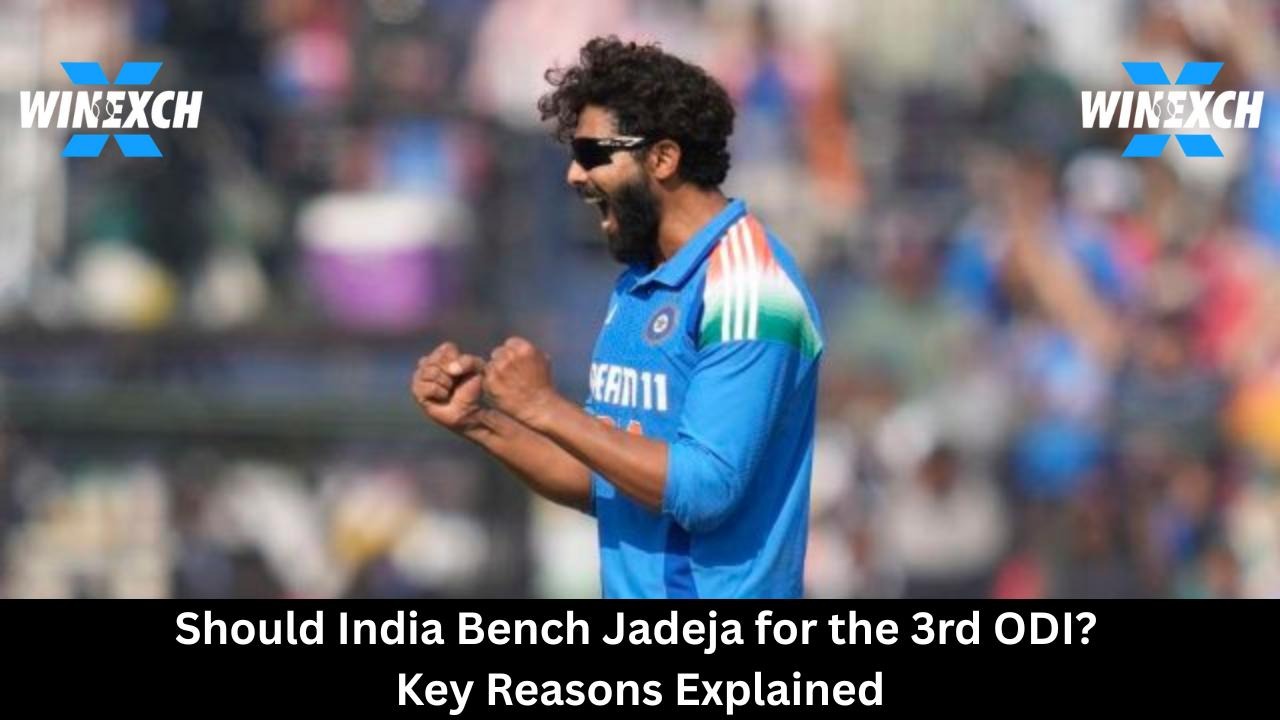
India dropping Ravindra Jadeja 3rd ODI? Truth Explained
Is India dropping Ravindra Jadeja in the 3rd ODI?
The exclusion of Ravindra Jadeja in the second ODI got enough tongues wagging, and of course, which led to fans and experts in divided opinions. But India dropping Ravindra Jadeja 3rd ODI is purely based on form, condition of play and the strength of the opponent.
While Jadeja remains a proven all-rounder, recent numbers raise serious concerns. Therefore, India dropping Ravindra Jadeja may look harsh, but it appears logical after close analysis.
Winexchange experts believe team balance matters more than reputation. As a result, selectors often act decisively. The three main reasons for such a contrarian call are worth considering.
Why Did India Drop Ravindra Jadeja for the 3rd ODI?
India dropping Ravindra Jadeja 3rd ODI was not for nothing. The team management focused on impact, not past achievements. Although Jadeja has an impressive ODI career, his recent returns fail to justify selection for a crucial clash.
Moreover, India already fields a settled batting order. Hence, Jadeja’s role depends heavily on bowling influence and late-order hitting. Unfortunately, both areas show a visible dip.
Winexch analysts pointed out these factors during post-match reviews.
Why Has Jadeja’s Batting Impact Reduced in ODIs?
Jadeja generally bats at No. 7 or No. 8. Thus, he needs to score quickly in the death overs. But this is not what some newer stats indicate, however.
Jadeja has managed just 419 runs from 25 ODI innings since 2023. His batting strike rate is 82.48. Most importantly, he struck only five sixes in that span. That output does not match modern lower-order demands.
Moreover, India expects finishers to clear boundaries under pressure. Jadeja often rotates strike instead. While singles help stability, they fail to change momentum late in the innings.
As a result, India dropping Ravindra Jadeja makes sense from a batting perspective. Winexch cricket insights also highlight this declining finishing ability.
Additionally, India already has depth in top and middle order batting. Therefore, selectors need bowlers who can also strike hard late. Jadeja no longer guarantees that edge.
Has Jadeja’s Wicket-Taking Ability Declined?
Jadeja remains economical. However, ODI cricket values wickets over containment. Sadly, his strike power has reduced.
In the first ODI, New Zealand batters played him comfortably. They rotated strike with ease. They took risks only when needed. That approach neutralised his threat.
Jadeja has played 11 ODIs since the beginning of 2025. He has taken only 12 wickets. He has an average of 38.08 with the ball. His strike rate extends to 47.50. These numbers fail to meet elite spinner standards.
Even more concerning, he completed his full 10-over quota only twice. In his last four matches, he managed just one wicket.
Therefore, India dropping Ravindra Jadeja aligns with tactical planning. Win Exchange match breakdowns stress that spinners must break partnerships, not just control runs.
India needed attacking options in the middle overs. Hence, selectors explored alternatives that offer sharper wicket-taking ability.
Jadeja’s Struggle Against New Zealand
Matchups matter greatly in international cricket. However, Jadeja doesn’t have a great ODI record against New Zealand.
He has faced 17 Black Caps innings. In that period, he took a mere 10 wickets. His bowling average against them is 77.60. His strike rate touches 91.2. Even his economy rate rises to 5.10.
These numbers highlight a clear pattern. New Zealand batters read him well. They rarely lose wickets to his variations.
Although Jadeja has scored useful runs against them, India does not require extra batting depth. The bowling performance carries more weight.
Therefore, India dropping Ravindra Jadeja becomes a matchup-based decision. Win Exch previews consistently emphasise opponent-specific planning in modern cricket.
Selectors clearly prioritised bowlers who pose a greater threat to New Zealand’s lineup.
What Does This Decision Mean for Team Balance?
India aims to build a flexible ODI unit. Therefore, each player must contribute decisively. Jadeja’s recent form raises doubts in both departments.
Dropping him does not signal the end. Instead, it reflects a short-term strategy. India may still rely on him in different conditions or formats.
Winexch cricket experts believe rotation ensures long-term success. Managing workload also plays a role.
For now, India needed a sharper impact. Hence, the decision stands justified.
Final Verdict on India Dropping Ravindra Jadeja
India dropping Ravindra Jadeja 3rd ODI decision is purely is based on data, not emotion His batting was so dour and his wickets so few that selection pressure had to be applied on him due to poor output with the bat.
While Jadeja remains a valuable asset, current conditions demand alternatives. Therefore, selectors acted decisively.
Winexch analysis supports this move from a tactical standpoint. Cricket is a changing game, and one must adjust to it quickly.
FAQs
Is India dropping Ravindra Jadeja for the 3rd ODI?
India let him go because of a low-key impact with the bat, no runs from seven innings, wicket-taking returns not worthy of a barter exchange and an abysmal record against New Zealand.
Has Ravindra Jadeja’s ODI form declined recently?
It is, yup, his batting striking rate and the frequency to take wickets have diminished since 2023.
Does this mean Jadeja is out of India’s future ODI plans?
Sorry, but this is due to form and conditions, not a lifetime ban.
How has Jadeja performed against New Zealand in ODIs?
He has bagged just 10 wickets in 17 innings at an abysmally high average of 77.60.
What do experts say about this decision?
Winexch experts view this move as a data-driven and matchup-based strategy.