




















What Is the DLS Method in Cricket? Explained in Simple Words
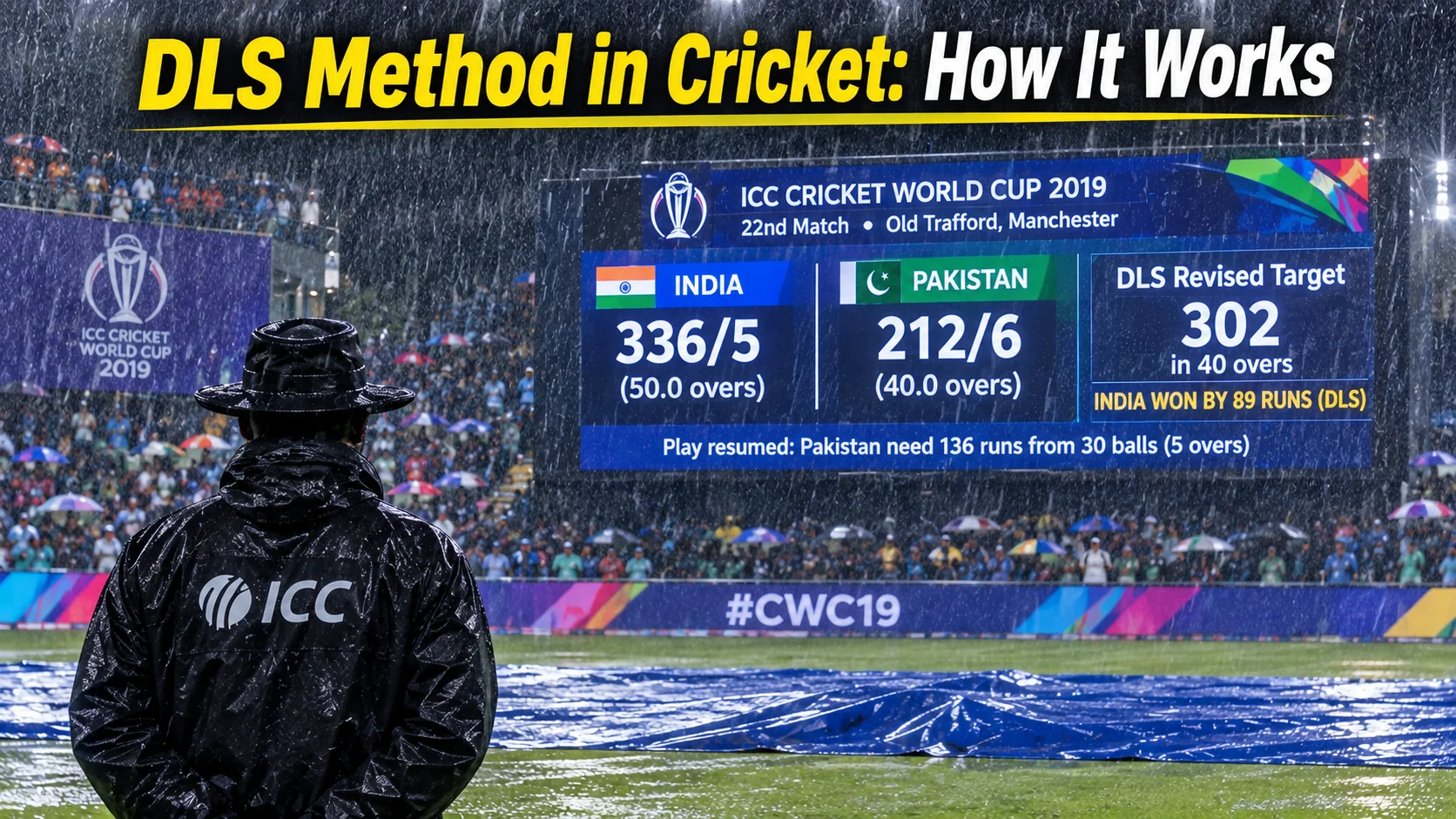
When it rains, a big run chase ends. Players run off the field. The big screen makes fans question. A new score goal appears on the screen. If you’re asking, “How did they come up with that new number?” you’re not the only one. The DLS method in cricket is the official method for resetting target scores in a cricket match when the game ends due to bad weather.
This system is so easy to understand. It does not require advanced mathematical concepts. It is at its heart a simple tracking of two basic assets: overs left and wickets in hand. After witnessing the operation of these two items, it will be easy and fun to follow rain games.
What Is the DLS Method in Cricket and How Does It Work?
The DLS method in cricket is a straightforward formula for making adjustments to target scores when it rains. Both teams will be looking to use 50 overs or 20 overs (whichever applies to the game) in normal 50-over or 20-over cricket. However, when it rains, it’s not fair to simply divide total runs by lost overs.
Frank Duckworth and Tony Lewis developed the Duckworth-Lewis method rather than a simple division method. Steven Stern later updated it. In this system, all games are based on one concept – “resources”.
Total Team Resources (100%) = Overs Remaining + Wickets in Hand
Each team begins each turn of batting with 100% of its resources. The resource level decreases as balls are bowled and wickets are lost. If it rains enough to put an end to play, officials verify the exact percentage of playing resources used by both teams in the DLS cricket. Afterwards, they adjust the target number up or down depending on the difference between the two.
Why Wickets Matter: The Concept of Resources
Old structures simply took into consideration lost overs. That method failed as it disregarded a vital aspect within the DLS method in cricket: how many batters remained ready to play. Losing overs hurts a group some distance extra once they retain 9 wickets, and then once they preserve only 1 wicket.
Key Factors Behind Team Resources:
Balls Remaining (Time): The number of balls that could be utilised in order to score runs.
Wickets in Hand (Batting Power): The remaining number of batters.
See two different types of groups spending a day inside due to a rain postponement:
| Team Situation | Resource Impact | Why It Matters |
| 100/2 with 5 overs lost | Low Loss | The team has plenty of batters left to hit hard when play starts again. |
| 100/9 with 5 overs lost | High Loss | The team was close to out, so extra overs add very little value. |
The Duckworth-Lewis Stern method measures these exact moments using updated statistical tables. It demonstrates that 5 overs with 8 wickets remaining is worth much more than 5 overs with only 1 wicket remaining.
How Target Scores Get Calculated in Different Scenarios
The DLS method in cricket changes targets depending on the timing of the rain. Since it’s a rainy day, target numbers change depending on which team loses their setup time.
Scenario 1: Rain Interrupts the Second Innings
If rain stops before Team 1 can play all their overs, Team 2 (chasing) loses overs and time. Officials reduce Team 2’s target score because Team 2 possesses fewer total resources than Team 1.
Scenario 2: Rain Interrupts the First Innings
If it does not rain, Team 1 loses overs and has to pace for a long game. Officials increase Team 2’s target score because Team 2 knows their exact target right from the first ball.
Minimum Overs Needed for a Result
Matches cannot end after just a few balls. To receive an official result according to the DLS method in cricket rules:
- T20 games need the chasing side to play at least 5 overs.
- ODI games need the chasing side to play at least 20 overs.
If the game is unable to be played because of bad weather before these limits, it is called a “No Result.
The Historical Shift: Why Older Methods Failed
In the pre-modern era, the “Most Productive Overs” method served as a weak rule for cricket. That rule created massive trouble during the 1992 World Cup.
When rain stopped play, South Africa needed 22 runs off 13 balls against England. Under old rules, officials dropped England’s two lowest-scoring overs. This forced South Africa to chase an impossible 21 runs off just 1 ball!
All of the problems associated with the old method of calculation were corrected by introducing the DLS system. Now the modern sports websites like Winexch, including the mentioned one, comply with the standards of the updated formula for the matches, which involves losses of wickets and the necessary adjustments for rain delays.
Understanding the Par Score in Live Action
During rain-affected matches, TV screens display a key number under the DLS rule in cricket known as the ‘par score’.
“The Par Score is the number of runs Team 2 must score in the next over or wicket lost to match Team 1’s score.”
If rain stops the game for good:
- Hitting past the par score means the chasing side triumphs.
- Falling short of the par score means the chasing side loses.
- Matching the Par Score exactly makes it a tie.
Numbers are important to keep things clear, and every ball counts. While the DLS method in cricket handles rain-shortened matches, watching any live game that involves a world record (such as the fastest 100 in Test cricket) becomes far more exciting when you understand how these numbers shape key historic moments.
Common Misconceptions About the DLS Method
Even die-hard fans can be confused about how the DLS method in cricket works in an actual match.
Here are three common myths set straight:
- Myth: Targets have a simple average run rate.
Fact: SRs don’t pay attention to wickets left or not.
- Myth: After it rains, the target score always decreases.
Fact: When Team 1 halts prematurely, Team 2’s goal is likely to rise to equalise Team 1’s perception of the goal.
- Myth: The formula is always the same.
Fact: Computer data tables update often to keep up with modern fast-paced scoring rates.
Final Recap
Players who learn the DLS method in cricket can handle rain breaks easily. This technique keeps every match fair, even when rain stops the game at any stage, by balancing remaining runs and wickets.
Knowing the DLS full form can be useful when watching Winexchange matches or high-profile events. Thus, you will not be confused when it comes to rain interruptions, and you can enjoy playing every match!