




















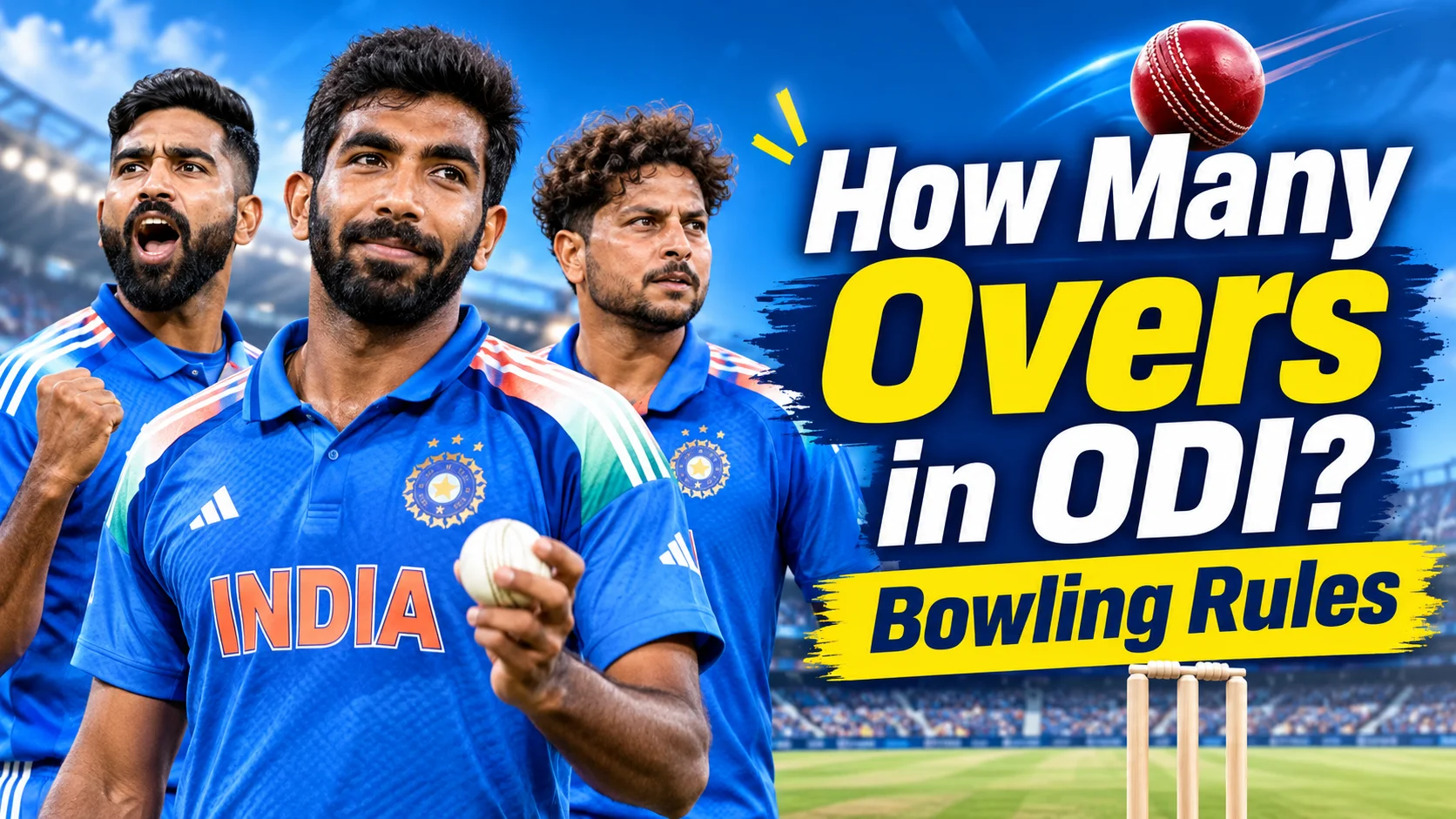
How Many Overs in ODI? Can One Bowler Really Bowl Only 10?
Cricket fans often ask how many overs in ODI matches shape the pace of play. The answer seems simple; however, the bowling rules add an interesting layer of strategy. A standard One Day International gives each batting side a maximum of 50 overs.
Therefore, both teams together play a total of 100 overs in a match. Also, one bowler cannot bowl more than 10 overs in a single innings. This rule ensures fairness, manages the workload of players and makes sure that captains use different bowlers.
How Many Overs in ODI Cricket?
The Basic ODI Format
One Day International cricket is abbreviated as ODI, and it lies somewhere in between Test cricket and Twenty20 cricket. The teams get one inning, which could span a maximum of 50 overs. For this reason, the number of overs in ODI cricket becomes obvious to everyone.
An over contains six legal deliveries, so a full ODI innings contains 300 balls. Therefore, the question of how many balls in ODI matches has a very simple answer.
ODI Match Overs Explained
The term ODI match overs refers to the total overs available to each side. Team A bats first and can face as many as 50 overs before losing wickets. Team B then also chases the target within its own allowance of 50 overs.
As a consequence, the second team should make more scores than the first one. In case of any rains that cause stoppage during the match, the number of overs is reduced.
How Many Overs in ODI Per Team?
The 50-Over Rule
How many overs in ODI per team remains fixed at 50 in a full match. This number has defined the format since ODI cricket became a major international competition. Both sides will get 300 legal balls provided they do not lose all 10 wickets before that.
Apart from this, a team may also conclude their innings ahead of schedule when they manage to achieve the desired target. Thus, 50 overs give adequate time for both these processes.
What Happens During Rain?
Weather can reduce the number of overs available to either one or both teams. In such cases, the bowling quota changes according to the revised length of the innings. The ICC states that no bowler may bowl more than one fifth of the revised total.
For example, a 40 over match allows each bowler a maximum of eight overs. Similarly, a 45 over match allows every bowler a maximum of nine overs in total. However, when the revised total does not divide evenly by five, one extra over applies. Therefore, a 47 over match may allow certain bowlers to deliver up to ten overs.
How Many Overs in an ODI Match?
Total Overs in a Match
How many overs in an ODI match depends on the scheduled length of play. In a full match, the two sides share a combined total of 100 overs between them. The side batting first can use all 50 overs or lose all ten wickets earlier.
Similarly, the chasing side also receives the same maximum allowance under normal ODI playing conditions. Therefore, fans should remember that 100 overs represents the combined total, not one team’s allowance.
Reduced Matches
Rain, poor light, or other interruptions can sometimes shorten an ODI match quite significantly. Officials then recalculate the target using the revised number of overs for both competing sides.
Consequently, the bowling limit also changes instead of remaining fixed at exactly 10 overs per bowler. For instance, a 30 over match allows each bowler a maximum of six overs.
Similar to this is the fact that a 35-over game allows the bowlers to have up to seven overs each. Such measures make sure that the game remains balanced without changing its basic format.
How Many Balls in ODI?
Six Balls Per Over
The question of how many balls in ODI cricket has a clear and consistent answer. Six deliveries make up each over, so an inning of 50 overs is made up of 300 balls. This means that a full ODI match has 600 legal deliveries in both innings.
However, wides and no balls do not count among these six legal deliveries per over. The bowler must deliver additional balls until the over reaches exactly six valid legal deliveries.
Why Extras Matter
Extras can extend an over beyond the usual six deliveries in certain situations. For instance, a wide or a no-ball is a free ball for the batting team. This means that the bowlers should be careful since the extras may influence the pace of the innings.
In addition, extras can affect the run rate when chasing. This means that discipline is as important as taking wickets in ODI cricket.
How Bowlers Use Their 10 Overs
Early Overs
Fast bowlers are more likely to bowl in the opening overs where the ball remains fresh. Also, the restrictions on fielding make this stage conducive to a fast line and length.
Hence, it is common for teams to reserve their best fast bowlers to begin an innings with.
Middle Overs
The spinners generally dominate the middle overs as the condition of the pitch becomes slower. Moreover, the spinners can have a tighter line and make the batters play aggressively. The middle overs can thus determine the course of the whole game.
The captain has to be very careful while choosing the spinners.
Final Overs
Fast bowlers come back into play during the last few overs since they can bowl Yorkers and slower balls. Furthermore, these overs become decisive when the batting team requires rapid scoring runs.
Therefore, captains must save enough overs from their best bowlers for this crucial stage. A well planned final spell can change the result of a close ODI match.
Key ODI Bowling Rules
- Each team receives a maximum total of 50 overs during a standard ODI match.
- One bowler cannot deliver more than 10 overs during one full ODI innings of play.
- A reduced match allows each bowler one fifth of the revised total number of overs.
- Six legal deliveries make one over, while wides and no balls require additional deliveries.
- Captains must use at least five different bowlers to complete a full 50 over innings.
- A partial over still counts as one full over for the original bowler.
Conclusion
Then how many overs are there in ODI matches that every cricket lover needs to know very well by now? Every team gets 50 overs, whereas one player gets the maximum of 10 overs.
This is all about creating a balance, protecting the bowlers, and making the captains make proper rotations in their bowling line-up. Winexchange makes sure cricket lovers get to learn such rules very well through accurate and very reliable information.